Chapter IV: The Odyssey of Europe
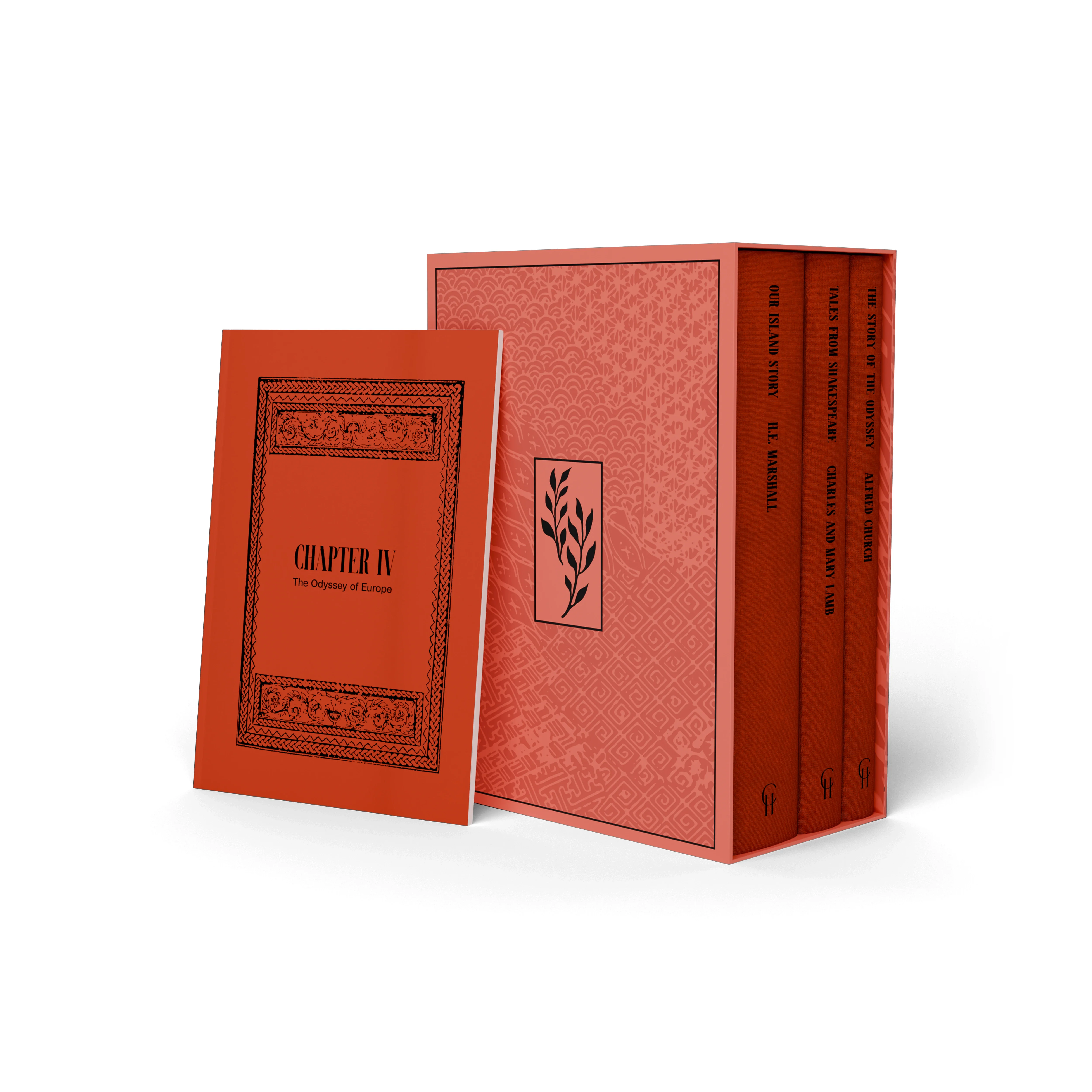
CHAPTER IV BOX SET (This is a pre-order and ships in the second half of June!)
This is the culmination of the Chapter House experience: the return home through history, literature, and the English language at its height. Chapter IV brings children to the Odyssey, Anglo history, and Shakespeare, completing the arc of the Western Canon.
We recommend adding the Sixth Grade bundle to extend that work into daily practice through mathematics, grammar, history, and the great novels that mark the transition into mature reading.
- The Story of the Odyssey
- Our Island Story
- Tales from Shakespeare
- Companion Pamphlet
ABOUT THE BOOKS
The Story of the Odyssey
If The Iliad is a story about war, The Odyssey is a story about what comes after. After the fall of Troy, King Odysseus, the cleverest of the Greek heroes, sets sail for home and spends ten years not getting there. He blinds the cyclops Polyphemus and earns the wrath of Poseidon. He resists the song of the Sirens. He descends to the realm of the dead to consult the shade of a prophet. He spends years trapped on an island. And through it all, back in Ithaca, his wife Penelope holds off a hall full of suitors who have given him up for dead, and his son grows from a boy into a man without him.
Alfred J. Church's The Story of the Odyssey is the direct companion to his Story of the Iliad from Chapter III, told in the same clear, slightly archaic prose that preserves the epic's tone without making it inaccessible. Children who have read The Iliad will find themselves in familiar hands, and in a very different story. Where the Iliad accumulates deaths, the Odyssey is, beneath all its violence, a story of homecoming and perseverance. Odysseus does not survive because he is the strongest. He survives because he never quits.
Church includes pronunciation guides throughout to help with the difficult Greek names, and his narrative brings the major episodes to life with enough vividness to hold even a reluctant reader. Children who have followed the Chapter House series from the beginning will recognize Odysseus here: They first met him as a character in the myths of Chapter I, then saw him at Troy in Chapter III. His homecoming closes the loop.
This Chapter House edition features sixteen illustrations: New color art commissioned from Ruxandra Ionce alongside restored classic Flaxman-style line art.
Ages 9–12 | 4th–6th grade
Our Island Story
H. E. Marshall's Our Island Story (1905) opens with the words "Once upon a time." This is not an accident. Marshall wanted her history of Britain shelved next to Robinson Crusoe. She did not write it for scholars. She wrote it for children who love stories, and she trusted that the history of Britain, properly told, was as gripping as any adventure novel.
She was right. In 110 chapters, Marshall covers the entire sweep of British history from its mythological origins (Neptune gives the island to his son Albion, echoing Virgil's gift of Roman heritage to the Trojans) through the death of Queen Victoria. The Romans arrive and leave. The Saxons settle. The Danes invade. William the Conqueror takes the throne. The Plantagenets build and fight. Henry VIII marries (and marries). Elizabeth defeats the Armada. Cromwell and Charles. Nelson and Napoleon. Victoria and the Empire. Marshall finds the stories that stick, and she tells them with heroes and villains and no pretense of false objectivity.
For American families, this is not a foreign story. The founding fathers were British. The original colonies were British colonies. The de facto language of this country is English. Understanding Britain is understanding ourselves.
Marshall includes King Arthur and Robin Hood alongside Magna Carta and the Battle of Agincourt, because she understood that the tall tales of a civilization are as important as its verified facts. "They are part of Our Island Story," she wrote, "and ought not to be forgotten."
This Chapter House edition restores all of A. S. Forrest's original color illustrations and includes an editorial note addressing Marshall's imperial-era perspectives on other peoples.
Ages 9–12 | 4th–6th grade
Tales from Shakespeare
Shakespeare is the mountain. Every student of English literature must eventually climb it. Phrases we use without thinking ("too much of a good thing," "it's Greek to me," "all that glitters," "the lady doth protest too much," "the world's my oyster") come from his plays. He is not merely part of the English literary tradition. He is part of the English language itself.
Charles and Mary Lamb's Tales from Shakespeare (1807) has been introducing children to the plays for over two centuries. Their method is elegant: Retell each play as a prose narrative, preserving Shakespeare's own language wherever the story will bear it. Twenty plays are included: The great tragedies, the comedies, the romances. Hamlet, Macbeth, Romeo and Juliet, Othello, King Lear. The Tempest, A Midsummer Night's Dream, The Merchant of Venice, As You Like It, Twelfth Night.
One of the gifts this book gives is recognition. A child who has read the Lambs' retelling of Hamlet and then watches The Lion King will suddenly understand what the film was doing: The uncle, the father's ghost, the young prince who hesitates. Stories that came after Shakespeare are full of him, and once a child knows the plays, those echoes are everywhere.
The Lambs wrote for children who had not yet read the plays themselves. They do not rewrite Shakespeare in modern English. They use his words, embedded in their own prose, so that a child absorbs the rhythms and vocabulary of the plays without realizing it. When that child later encounters Hamlet or The Tempest in its original form, the language will feel familiar. That is the gift.
It is worth knowing that the lives of Charles and Mary Lamb were worthy of a Shakespearean tragedy themselves. Mary, who suffered from severe mental illness, murdered their mother in 1796. Charles dedicated his life to her care. Despite this, they presided over a literary circle that included Coleridge and Wordsworth, and Tales from Shakespeare remains the finest introduction to the plays ever written.
This Chapter House edition restores more than thirty illustrations by Louis Rhead, a feature no other edition currently in print provides.
Ages 9–12 | 4th–6th grade
The Chapter IV Pamphlet
-
"Virtus et Miraculum": The founding essay of Chapter House. An argument for why virtue is the proper aim of education and why story is the best way to cultivate it, drawing on Aristotle, Marcus Aurelius, Benjamin Franklin, John Adams, Confucius, and St. John Chrysostom.
-
Introduction to Chapter IV: The Odyssey of Europe: An overview of all three books and how they fit together.
-
Literary Essays: Individual essays on The Story of the Odyssey (including the contrast with the Iliad, Odysseus as a prefigurement of Christ, and how to use Pope's translation alongside Church's prose), Our Island Story (British heritage as American heritage, Marshall's method, the importance of tall tales in national memory), and Tales from Shakespeare (why Shakespeare matters, how the Lambs' method works, the biographical context of Charles and Mary Lamb, and Shakespeare's phrases embedded in modern English).
-
How to Enjoy These Titles with Your Children: Guidance for the upper-elementary years, including written narrations, pre-reading for parent discussion, and using maps alongside the history text.
-
A Sample Day with Chapter IV: A full sample daily schedule showing how the Chapter House books fit alongside mathematics, handwriting, nature study, and other subjects.
-
An Introduction to Homeschooling: For families new to home education.
-
A Survey of Educational Philosophies: Charlotte Mason, Classical, Montessori, Waldorf, and Orton-Gillingham approaches.
-
Why You Should Read the Bible: A case for biblical literacy regardless of faith background, with a reading list.
-
A Note to Christian Parents Apprehensive About Ancient Mythology: A thorough response to concerns about pagan mythology, drawing on St. Paul, St. Basil the Great, J. R. R. Tolkien, and C. S. Lewis.
-
Greek vs. Roman Names: A reference table for the gods and heroes who appear across the series.
Original: $99.50
-65%$99.50
$34.82Product Information
Product Information
Shipping & Returns
Shipping & Returns
Description
CHAPTER IV BOX SET (This is a pre-order and ships in the second half of June!)
This is the culmination of the Chapter House experience: the return home through history, literature, and the English language at its height. Chapter IV brings children to the Odyssey, Anglo history, and Shakespeare, completing the arc of the Western Canon.
We recommend adding the Sixth Grade bundle to extend that work into daily practice through mathematics, grammar, history, and the great novels that mark the transition into mature reading.
- The Story of the Odyssey
- Our Island Story
- Tales from Shakespeare
- Companion Pamphlet
ABOUT THE BOOKS
The Story of the Odyssey
If The Iliad is a story about war, The Odyssey is a story about what comes after. After the fall of Troy, King Odysseus, the cleverest of the Greek heroes, sets sail for home and spends ten years not getting there. He blinds the cyclops Polyphemus and earns the wrath of Poseidon. He resists the song of the Sirens. He descends to the realm of the dead to consult the shade of a prophet. He spends years trapped on an island. And through it all, back in Ithaca, his wife Penelope holds off a hall full of suitors who have given him up for dead, and his son grows from a boy into a man without him.
Alfred J. Church's The Story of the Odyssey is the direct companion to his Story of the Iliad from Chapter III, told in the same clear, slightly archaic prose that preserves the epic's tone without making it inaccessible. Children who have read The Iliad will find themselves in familiar hands, and in a very different story. Where the Iliad accumulates deaths, the Odyssey is, beneath all its violence, a story of homecoming and perseverance. Odysseus does not survive because he is the strongest. He survives because he never quits.
Church includes pronunciation guides throughout to help with the difficult Greek names, and his narrative brings the major episodes to life with enough vividness to hold even a reluctant reader. Children who have followed the Chapter House series from the beginning will recognize Odysseus here: They first met him as a character in the myths of Chapter I, then saw him at Troy in Chapter III. His homecoming closes the loop.
This Chapter House edition features sixteen illustrations: New color art commissioned from Ruxandra Ionce alongside restored classic Flaxman-style line art.
Ages 9–12 | 4th–6th grade
Our Island Story
H. E. Marshall's Our Island Story (1905) opens with the words "Once upon a time." This is not an accident. Marshall wanted her history of Britain shelved next to Robinson Crusoe. She did not write it for scholars. She wrote it for children who love stories, and she trusted that the history of Britain, properly told, was as gripping as any adventure novel.
She was right. In 110 chapters, Marshall covers the entire sweep of British history from its mythological origins (Neptune gives the island to his son Albion, echoing Virgil's gift of Roman heritage to the Trojans) through the death of Queen Victoria. The Romans arrive and leave. The Saxons settle. The Danes invade. William the Conqueror takes the throne. The Plantagenets build and fight. Henry VIII marries (and marries). Elizabeth defeats the Armada. Cromwell and Charles. Nelson and Napoleon. Victoria and the Empire. Marshall finds the stories that stick, and she tells them with heroes and villains and no pretense of false objectivity.
For American families, this is not a foreign story. The founding fathers were British. The original colonies were British colonies. The de facto language of this country is English. Understanding Britain is understanding ourselves.
Marshall includes King Arthur and Robin Hood alongside Magna Carta and the Battle of Agincourt, because she understood that the tall tales of a civilization are as important as its verified facts. "They are part of Our Island Story," she wrote, "and ought not to be forgotten."
This Chapter House edition restores all of A. S. Forrest's original color illustrations and includes an editorial note addressing Marshall's imperial-era perspectives on other peoples.
Ages 9–12 | 4th–6th grade
Tales from Shakespeare
Shakespeare is the mountain. Every student of English literature must eventually climb it. Phrases we use without thinking ("too much of a good thing," "it's Greek to me," "all that glitters," "the lady doth protest too much," "the world's my oyster") come from his plays. He is not merely part of the English literary tradition. He is part of the English language itself.
Charles and Mary Lamb's Tales from Shakespeare (1807) has been introducing children to the plays for over two centuries. Their method is elegant: Retell each play as a prose narrative, preserving Shakespeare's own language wherever the story will bear it. Twenty plays are included: The great tragedies, the comedies, the romances. Hamlet, Macbeth, Romeo and Juliet, Othello, King Lear. The Tempest, A Midsummer Night's Dream, The Merchant of Venice, As You Like It, Twelfth Night.
One of the gifts this book gives is recognition. A child who has read the Lambs' retelling of Hamlet and then watches The Lion King will suddenly understand what the film was doing: The uncle, the father's ghost, the young prince who hesitates. Stories that came after Shakespeare are full of him, and once a child knows the plays, those echoes are everywhere.
The Lambs wrote for children who had not yet read the plays themselves. They do not rewrite Shakespeare in modern English. They use his words, embedded in their own prose, so that a child absorbs the rhythms and vocabulary of the plays without realizing it. When that child later encounters Hamlet or The Tempest in its original form, the language will feel familiar. That is the gift.
It is worth knowing that the lives of Charles and Mary Lamb were worthy of a Shakespearean tragedy themselves. Mary, who suffered from severe mental illness, murdered their mother in 1796. Charles dedicated his life to her care. Despite this, they presided over a literary circle that included Coleridge and Wordsworth, and Tales from Shakespeare remains the finest introduction to the plays ever written.
This Chapter House edition restores more than thirty illustrations by Louis Rhead, a feature no other edition currently in print provides.
Ages 9–12 | 4th–6th grade
The Chapter IV Pamphlet
-
"Virtus et Miraculum": The founding essay of Chapter House. An argument for why virtue is the proper aim of education and why story is the best way to cultivate it, drawing on Aristotle, Marcus Aurelius, Benjamin Franklin, John Adams, Confucius, and St. John Chrysostom.
-
Introduction to Chapter IV: The Odyssey of Europe: An overview of all three books and how they fit together.
-
Literary Essays: Individual essays on The Story of the Odyssey (including the contrast with the Iliad, Odysseus as a prefigurement of Christ, and how to use Pope's translation alongside Church's prose), Our Island Story (British heritage as American heritage, Marshall's method, the importance of tall tales in national memory), and Tales from Shakespeare (why Shakespeare matters, how the Lambs' method works, the biographical context of Charles and Mary Lamb, and Shakespeare's phrases embedded in modern English).
-
How to Enjoy These Titles with Your Children: Guidance for the upper-elementary years, including written narrations, pre-reading for parent discussion, and using maps alongside the history text.
-
A Sample Day with Chapter IV: A full sample daily schedule showing how the Chapter House books fit alongside mathematics, handwriting, nature study, and other subjects.
-
An Introduction to Homeschooling: For families new to home education.
-
A Survey of Educational Philosophies: Charlotte Mason, Classical, Montessori, Waldorf, and Orton-Gillingham approaches.
-
Why You Should Read the Bible: A case for biblical literacy regardless of faith background, with a reading list.
-
A Note to Christian Parents Apprehensive About Ancient Mythology: A thorough response to concerns about pagan mythology, drawing on St. Paul, St. Basil the Great, J. R. R. Tolkien, and C. S. Lewis.
-
Greek vs. Roman Names: A reference table for the gods and heroes who appear across the series.