Chapter III: The Triumph of the West
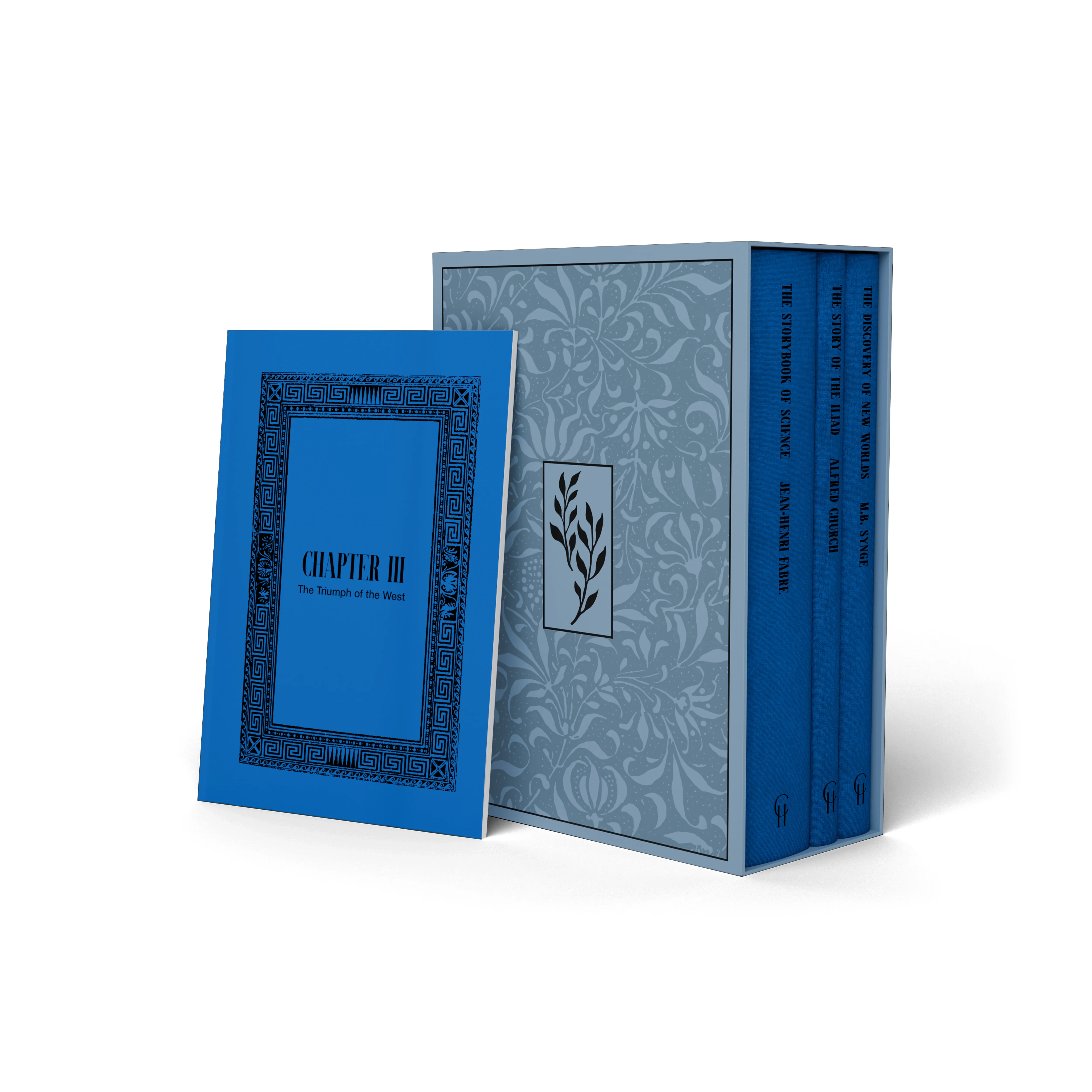
CHAPTER III BOX SET (This is a pre-order and ships in the second half of June!)
This is the ascent: the first encounter with epic poetry, the sweep of world history, and the disciplined study of the natural world. Chapter III brings children to Homer, to the long arc from Rome to the Age of Exploration, and to science taught through observation and wonder.
We recommend adding the Fourth and Fifth Grade bundles to extend that work into daily practice through mathematics, grammar, Latin, history, biography, and a growing body of sustained, independent reading.
- The Story of the Iliad
- The Discovery of New Worlds
- The Storybook of Science
- Companion Pamphlet
ABOUT THE BOOKS
The Story of the Iliad
Alfred J. Church's The Story of the Iliad (1891, children's edition 1907) is the best introduction to Homer for young readers that we have found. Church was a professor of Latin at University College London, a classical scholar who spent his career making the ancient world available to a wider audience. He knew the Greek text intimately, and his retelling preserves the sweep and grandeur of the original (Achilles' rage, Hector's courage, Priam's grief) while making it accessible to readers as young as eight.
The story begins before Homer does: Church opens with the cause of the war, Paris's abduction of Helen, so that young readers know from the first page what is at stake. From there, the twenty-three chapters follow the action through the quarrel between Achilles and Agamemnon, the deaths of Patroclus and Hector, and the ransoming of Hector's body by his father Priam. A brief epilogue covers the fall of Troy itself.
Children who met Achilles and Hector as names in Chapter I's mythology books will now encounter them as full characters in a great drama. The continuity is intentional. The Chapter House series is built so that each set deepens what came before, and nowhere is that more evident than here.
This Chapter House edition features sixteen illustrations: New color art commissioned from Ruxandra Ionce alongside restored classic line art in the neoclassical Flaxman style.
Ages 8–11 | 3rd–5th grade
The Discovery of New Worlds
M. B. Synge's The Discovery of New Worlds (1903) is the direct sequel to On the Shores of the Great Sea from Chapter II, picking up the story of Western civilization at the height of the Roman Empire and carrying it through a thousand years of upheaval, exploration, and rebirth: Augustus and Constantine, Charlemagne and the Vikings, the Crusades and the Black Death, Marco Polo and Columbus, Magellan and the conquistadores.
What Synge does better than any other writer of children's history is show how one era gives way to the next. She does not present Rome and the Middle Ages as separate subjects. She traces the thread. The decline of Rome sets the stage for the rise of Christianity. The Crusades open the trade routes that fund the Renaissance. The Renaissance produces the navigators who discover new worlds. A child who reads this book will come away understanding not just what happened, but why: How thirteen centuries of human history connect into a single story.
Each of the fifty chapters opens with a poetry epigraph from Tennyson, Browning, Shakespeare, or another master, a touch of elegance that most children's histories would never attempt. Synge expected her readers to rise to the material. They did.
This Chapter House edition features three new color illustrations by Cortney Skinner and preserves Synge's original text.
Ages 8–11 | 3rd–5th grade
The Storybook of Science
Jean-Henri Fabre was one of the greatest naturalists who ever lived. Darwin called him "an incomparable observer." Victor Hugo called him "the Homer of insects." Fabre spent his life studying the natural world with a patience and attention that modern science, for all its instruments and funding, rarely matches. And then he wrote about what he found, not in the dry language of academic journals, but in stories.
The Storybook of Science (1882, English translation by Florence Constable Bicknell) uses a simple narrative frame: Uncle Paul (Fabre himself) sits with three children and tells them stories about the world around them. Why does a spider spin a web? What makes a caterpillar become a butterfly? How do plants grow toward the light? Why do stars move across the sky? Each chapter is a conversation, a question answered through observation, analogy, and wonder. Eighty chapters cover zoology, botany, physics, earth science, astronomy, and more, moving between subjects naturally as the children's curiosity leads.
This is science taught the way Charlotte Mason taught everything: Through living ideas, not dead information. Fabre does not give children facts to memorize. He gives them questions to think about.
This Chapter House edition restores Fabre's original illustrations and adds sixteen corrective footnotes (signed --CH) where 19th-century science is outdated or potentially dangerous. Fabre's advice on snakebites, mushroom identification, and lightning safety reflects the knowledge of his time, which is sometimes wrong in ways that could cause real harm. Our footnotes correct these errors clearly and specifically.
Ages 8–11 | 3rd–5th grade
The Chapter III Pamphlet
The companion pamphlet, included with every Chapter III box set, is a full introduction to the books, the philosophy behind them, and the practice of reading them well.
Contents of the Chapter III pamphlet:
-
"Virtus et Miraculum": The founding essay of Chapter House. An argument for why virtue is the proper aim of education and why story is the best way to cultivate it, drawing on Aristotle, Marcus Aurelius, Benjamin Franklin, John Adams, Confucius, and St. John Chrysostom.
-
Introduction to Chapter III: The Triumph of the West: An overview of all three books and how they fit together.
-
Literary Essays: Individual essays on Homer and The Story of the Iliad (including a discussion of Church's adaptation compared to Alexander Pope's poetic translation), Synge's method in The Discovery of New Worlds (the BC/AD divide, Columbus, the rise of Christendom), and Fabre's approach in The Storybook of Science (wonder as the foundation of scientific inquiry, with notes on how to use the corrective footnotes).
-
How to Enjoy These Titles with Your Children: Guidance for the late-elementary years, including written narrations, pre-reading selections before discussion, and using maps and reference materials alongside the texts.
-
A Sample Day with Chapter III: A full sample daily schedule showing how the Chapter House books fit alongside mathematics, handwriting, nature study, and other subjects.
-
An Introduction to Homeschooling: For families new to home education.
-
A Survey of Educational Philosophies: Charlotte Mason, Classical, Montessori, Waldorf, and Orton-Gillingham approaches.
-
Why You Should Read the Bible: A case for biblical literacy regardless of faith background, with a reading list.
-
A Note to Christian Parents Apprehensive About Ancient Mythology: A thorough response to concerns about pagan mythology, drawing on St. Paul, St. Basil the Great, J. R. R. Tolkien, and C. S. Lewis.
-
Greek vs. Roman Names: A reference table for the gods and heroes who appear in multiple forms across the series.
Original: $99.50
-65%$99.50
$34.82Product Information
Product Information
Shipping & Returns
Shipping & Returns
Description
CHAPTER III BOX SET (This is a pre-order and ships in the second half of June!)
This is the ascent: the first encounter with epic poetry, the sweep of world history, and the disciplined study of the natural world. Chapter III brings children to Homer, to the long arc from Rome to the Age of Exploration, and to science taught through observation and wonder.
We recommend adding the Fourth and Fifth Grade bundles to extend that work into daily practice through mathematics, grammar, Latin, history, biography, and a growing body of sustained, independent reading.
- The Story of the Iliad
- The Discovery of New Worlds
- The Storybook of Science
- Companion Pamphlet
ABOUT THE BOOKS
The Story of the Iliad
Alfred J. Church's The Story of the Iliad (1891, children's edition 1907) is the best introduction to Homer for young readers that we have found. Church was a professor of Latin at University College London, a classical scholar who spent his career making the ancient world available to a wider audience. He knew the Greek text intimately, and his retelling preserves the sweep and grandeur of the original (Achilles' rage, Hector's courage, Priam's grief) while making it accessible to readers as young as eight.
The story begins before Homer does: Church opens with the cause of the war, Paris's abduction of Helen, so that young readers know from the first page what is at stake. From there, the twenty-three chapters follow the action through the quarrel between Achilles and Agamemnon, the deaths of Patroclus and Hector, and the ransoming of Hector's body by his father Priam. A brief epilogue covers the fall of Troy itself.
Children who met Achilles and Hector as names in Chapter I's mythology books will now encounter them as full characters in a great drama. The continuity is intentional. The Chapter House series is built so that each set deepens what came before, and nowhere is that more evident than here.
This Chapter House edition features sixteen illustrations: New color art commissioned from Ruxandra Ionce alongside restored classic line art in the neoclassical Flaxman style.
Ages 8–11 | 3rd–5th grade
The Discovery of New Worlds
M. B. Synge's The Discovery of New Worlds (1903) is the direct sequel to On the Shores of the Great Sea from Chapter II, picking up the story of Western civilization at the height of the Roman Empire and carrying it through a thousand years of upheaval, exploration, and rebirth: Augustus and Constantine, Charlemagne and the Vikings, the Crusades and the Black Death, Marco Polo and Columbus, Magellan and the conquistadores.
What Synge does better than any other writer of children's history is show how one era gives way to the next. She does not present Rome and the Middle Ages as separate subjects. She traces the thread. The decline of Rome sets the stage for the rise of Christianity. The Crusades open the trade routes that fund the Renaissance. The Renaissance produces the navigators who discover new worlds. A child who reads this book will come away understanding not just what happened, but why: How thirteen centuries of human history connect into a single story.
Each of the fifty chapters opens with a poetry epigraph from Tennyson, Browning, Shakespeare, or another master, a touch of elegance that most children's histories would never attempt. Synge expected her readers to rise to the material. They did.
This Chapter House edition features three new color illustrations by Cortney Skinner and preserves Synge's original text.
Ages 8–11 | 3rd–5th grade
The Storybook of Science
Jean-Henri Fabre was one of the greatest naturalists who ever lived. Darwin called him "an incomparable observer." Victor Hugo called him "the Homer of insects." Fabre spent his life studying the natural world with a patience and attention that modern science, for all its instruments and funding, rarely matches. And then he wrote about what he found, not in the dry language of academic journals, but in stories.
The Storybook of Science (1882, English translation by Florence Constable Bicknell) uses a simple narrative frame: Uncle Paul (Fabre himself) sits with three children and tells them stories about the world around them. Why does a spider spin a web? What makes a caterpillar become a butterfly? How do plants grow toward the light? Why do stars move across the sky? Each chapter is a conversation, a question answered through observation, analogy, and wonder. Eighty chapters cover zoology, botany, physics, earth science, astronomy, and more, moving between subjects naturally as the children's curiosity leads.
This is science taught the way Charlotte Mason taught everything: Through living ideas, not dead information. Fabre does not give children facts to memorize. He gives them questions to think about.
This Chapter House edition restores Fabre's original illustrations and adds sixteen corrective footnotes (signed --CH) where 19th-century science is outdated or potentially dangerous. Fabre's advice on snakebites, mushroom identification, and lightning safety reflects the knowledge of his time, which is sometimes wrong in ways that could cause real harm. Our footnotes correct these errors clearly and specifically.
Ages 8–11 | 3rd–5th grade
The Chapter III Pamphlet
The companion pamphlet, included with every Chapter III box set, is a full introduction to the books, the philosophy behind them, and the practice of reading them well.
Contents of the Chapter III pamphlet:
-
"Virtus et Miraculum": The founding essay of Chapter House. An argument for why virtue is the proper aim of education and why story is the best way to cultivate it, drawing on Aristotle, Marcus Aurelius, Benjamin Franklin, John Adams, Confucius, and St. John Chrysostom.
-
Introduction to Chapter III: The Triumph of the West: An overview of all three books and how they fit together.
-
Literary Essays: Individual essays on Homer and The Story of the Iliad (including a discussion of Church's adaptation compared to Alexander Pope's poetic translation), Synge's method in The Discovery of New Worlds (the BC/AD divide, Columbus, the rise of Christendom), and Fabre's approach in The Storybook of Science (wonder as the foundation of scientific inquiry, with notes on how to use the corrective footnotes).
-
How to Enjoy These Titles with Your Children: Guidance for the late-elementary years, including written narrations, pre-reading selections before discussion, and using maps and reference materials alongside the texts.
-
A Sample Day with Chapter III: A full sample daily schedule showing how the Chapter House books fit alongside mathematics, handwriting, nature study, and other subjects.
-
An Introduction to Homeschooling: For families new to home education.
-
A Survey of Educational Philosophies: Charlotte Mason, Classical, Montessori, Waldorf, and Orton-Gillingham approaches.
-
Why You Should Read the Bible: A case for biblical literacy regardless of faith background, with a reading list.
-
A Note to Christian Parents Apprehensive About Ancient Mythology: A thorough response to concerns about pagan mythology, drawing on St. Paul, St. Basil the Great, J. R. R. Tolkien, and C. S. Lewis.
-
Greek vs. Roman Names: A reference table for the gods and heroes who appear in multiple forms across the series.