Chapter I: Heroes and Wonders
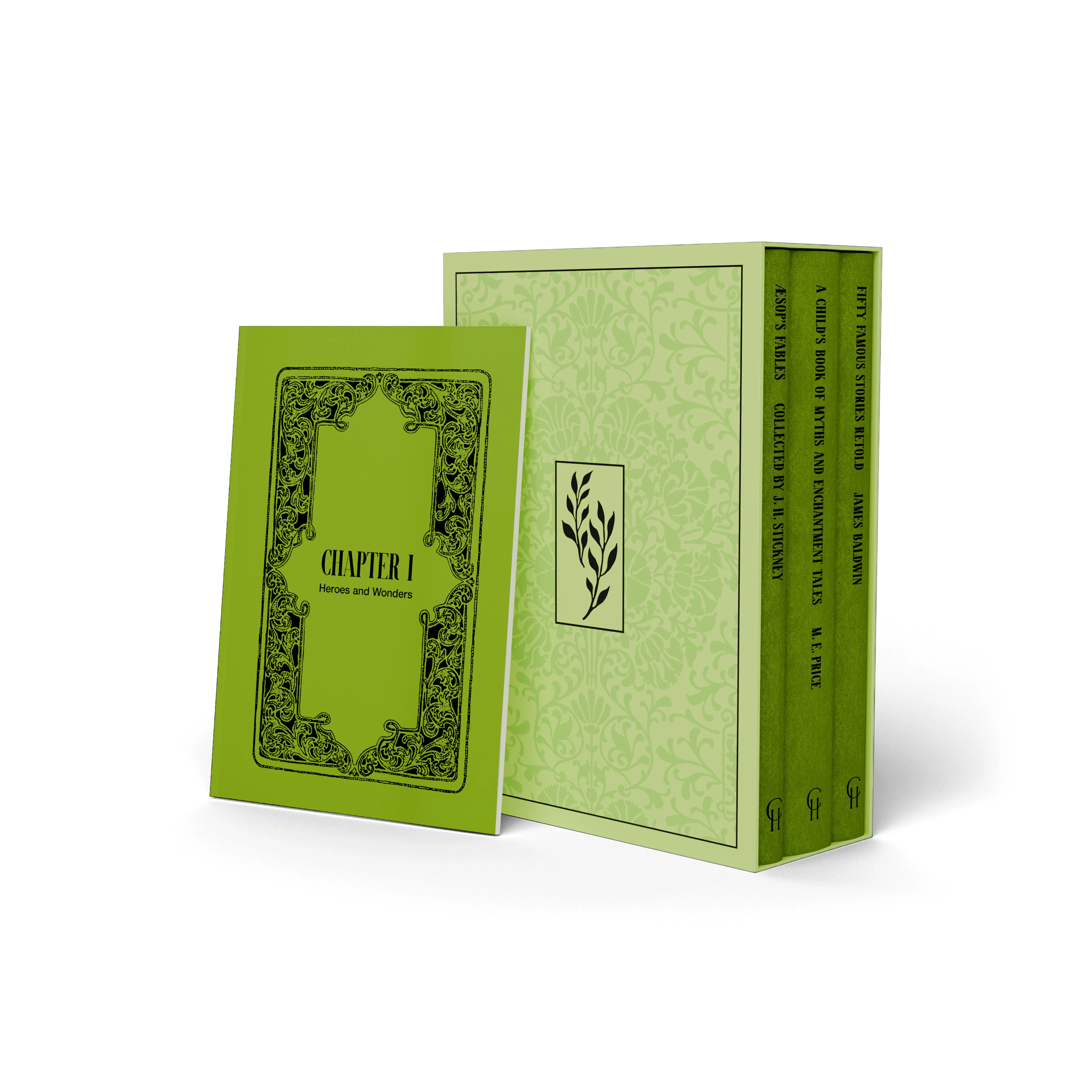
CHAPTER I BOX SET (This is a pre-order and ships in the second half of June!)
This is the beginning: the first encounter with the stories that shape a child's understanding of himself and the world. Chapter I gathers the fables and myths that have formed the foundation of Western education for centuries.
We recommend adding the Kindergarten and First Grade bundles to extend that foundation into daily practice through mathematics, handwriting, nature study, poetry, and a growing home library.
- Æsop’s Fables
- A Child’s Book of Myths & Enchantment Tales
- Fifty Famous Stories Retold
- Companion Pamphlet
ABOUT THE BOOKS
Æsop's Fables: A Version for Young Readers
J. H. Stickney's Æsop's Fables: A Version for Young Readers (1915) is the best adaptation of Æsop we have found for the early elementary years. Stickney understood that Æsop's power lies in the stories themselves, not in the morals appended to them. She resists the temptation to spell out the lesson at the end of each fable, trusting instead that a child who has heard "The Wolf and the Lamb" does not need a footnote explaining that the strong will always find an excuse to prey on the weak.
The fables include the familiar and the forgotten alike: "The Tortoise and the Hare," "The Fox and the Grapes," "The Boy Who Cried Wolf," "The Town Mouse and the Country Mouse," "The Lion and the Mouse," and dozens more. Each is short enough to read in two or three minutes, making them ideal for mornings before the day begins or evenings before bed.
This Chapter House edition restores Charles Livingston Bull's original illustrations. Bull was among the finest animal illustrators of his generation, and his work deserves recognition, not buried in an out-of-print edition.
Ages 5–8 | Kindergarten–2nd grade
A Child's Book of Myths and Enchantment Tales for Children
Margaret Evans Price wrote these myths because she believed children deserve to meet the gods and heroes of the ancient world through beautiful art and language that takes them seriously. She was right. A Child's Book of Myths (1924) and Enchantment Tales for Children (1926) have been quietly passed from parent to child for a century, loved for their warmth and for Price's extraordinary color illustrations.
You may know her name without knowing it: Price and her husband co-founded Fisher-Price, the toy company, and the first toys they produced were based on characters from her books. Her artwork inspired a generation of children's illustrators.
This Chapter House edition combines both books in a single volume and restores all of Price's original color illustrations. We also restored something missing from every other edition: The original introductions by Katharine Lee Bates, the poet who wrote "America the Beautiful." Bates understood that myths are not mere entertainment but the shared inheritance of a civilization, and she says so with a poet's clarity. No other affordable, in-print edition of this book exists.
The 28 myths include Daedalus and Icarus, Cupid and Psyche, Hercules, Proserpina, Prometheus, Pandora, Jason and the Golden Fleece, Perseus and Medusa, Orpheus and Eurydice, King Midas and the Golden Touch, and Romulus and Remus. A pronouncing vocabulary of proper names is included at the back.
Ages 5–8 | Kindergarten–2nd grade
Fifty Famous Stories Retold
James Baldwin (1841–1925) spent his career writing history and legend for children, and Fifty Famous Stories Retold (1896) is his masterpiece. The collection gathers short tales drawn from the history and legend of the Western world: King Alfred burning the cakes, the 300 Spartans at Thermopylae, William Tell shooting the apple, Cincinnatus called from his plow to save Rome, Horatius holding the bridge, George Washington and the cherry tree, Robin Hood and the Sheriff of Nottingham, Robert the Bruce watching the spider.
These are the stories that educated men and women once carried as common knowledge: The stories Lincoln knew, the stories your grandparents' grandparents might have known. Too many children today have never heard them.
Baldwin distinguished his stories from fairy tales by grounding them in reality. They may be legendary (the cherry tree story is almost certainly invented), but they are plausible enough to feel true, and the virtues they teach (courage, honesty, duty, sacrifice, perseverance) are real regardless of whether every detail is verified.
Each story runs two to four pages. This edition features five new color illustrations commissioned from Cortney Skinner.
Ages 5–8 | Kindergarten–2nd grade
The Chapter I Pamphlet
The companion pamphlet, included with every Chapter I box set, is a than a teaching guide, an introduction to the books, explains the philosophy behind selecting them, and provides suggestion for how to read them well.
Contents of the Chapter I pamphlet:
-
"Virtus et Miraculum": The founding essay of Chapter House. An argument for why virtue is the proper aim of education and why story is the best way to cultivate it, drawing on Aristotle, Marcus Aurelius, Benjamin Franklin, John Adams, Confucius, and St. John Chrysostom.
-
Introduction to Chapter I: Heroes and Wonders: An overview of all three books and how they fit together.
-
Literary Essays: Individual essays on Æsop and J. H. Stickney, Margaret Evans Price and the myths, and James Baldwin's method in Fifty Famous Stories Retold, including a close reading of "George Washington and His Hatchet" and the power of story in Lincoln's life.
-
How to Enjoy These Titles with Your Children: Practical guidance on read-aloud sessions, narration, comprehension questions, and pacing.
-
A Sample Day with Chapter I: A full sample daily schedule showing how the Chapter House books fit alongside mathematics, handwriting, nature study, and other subjects.
-
An Introduction to Homeschooling: For families new to home education.
-
A Survey of Educational Philosophies: Charlotte Mason, Classical, Montessori, Waldorf, and Orton-Gillingham approaches.
-
Why You Should Read the Bible: A case for biblical literacy regardless of faith background, with a reading list.
-
A Note to Christian Parents Apprehensive About Ancient Mythology: A thorough response to concerns about pagan mythology, drawing on St. Paul, St. Basil the Great, J. R. R. Tolkien, and C. S. Lewis.
-
Greek vs. Roman Names: A reference table for the gods and heroes who appear in multiple forms across the books.
Original: $99.50
-65%$99.50
$34.82Product Information
Product Information
Shipping & Returns
Shipping & Returns
Description
CHAPTER I BOX SET (This is a pre-order and ships in the second half of June!)
This is the beginning: the first encounter with the stories that shape a child's understanding of himself and the world. Chapter I gathers the fables and myths that have formed the foundation of Western education for centuries.
We recommend adding the Kindergarten and First Grade bundles to extend that foundation into daily practice through mathematics, handwriting, nature study, poetry, and a growing home library.
- Æsop’s Fables
- A Child’s Book of Myths & Enchantment Tales
- Fifty Famous Stories Retold
- Companion Pamphlet
ABOUT THE BOOKS
Æsop's Fables: A Version for Young Readers
J. H. Stickney's Æsop's Fables: A Version for Young Readers (1915) is the best adaptation of Æsop we have found for the early elementary years. Stickney understood that Æsop's power lies in the stories themselves, not in the morals appended to them. She resists the temptation to spell out the lesson at the end of each fable, trusting instead that a child who has heard "The Wolf and the Lamb" does not need a footnote explaining that the strong will always find an excuse to prey on the weak.
The fables include the familiar and the forgotten alike: "The Tortoise and the Hare," "The Fox and the Grapes," "The Boy Who Cried Wolf," "The Town Mouse and the Country Mouse," "The Lion and the Mouse," and dozens more. Each is short enough to read in two or three minutes, making them ideal for mornings before the day begins or evenings before bed.
This Chapter House edition restores Charles Livingston Bull's original illustrations. Bull was among the finest animal illustrators of his generation, and his work deserves recognition, not buried in an out-of-print edition.
Ages 5–8 | Kindergarten–2nd grade
A Child's Book of Myths and Enchantment Tales for Children
Margaret Evans Price wrote these myths because she believed children deserve to meet the gods and heroes of the ancient world through beautiful art and language that takes them seriously. She was right. A Child's Book of Myths (1924) and Enchantment Tales for Children (1926) have been quietly passed from parent to child for a century, loved for their warmth and for Price's extraordinary color illustrations.
You may know her name without knowing it: Price and her husband co-founded Fisher-Price, the toy company, and the first toys they produced were based on characters from her books. Her artwork inspired a generation of children's illustrators.
This Chapter House edition combines both books in a single volume and restores all of Price's original color illustrations. We also restored something missing from every other edition: The original introductions by Katharine Lee Bates, the poet who wrote "America the Beautiful." Bates understood that myths are not mere entertainment but the shared inheritance of a civilization, and she says so with a poet's clarity. No other affordable, in-print edition of this book exists.
The 28 myths include Daedalus and Icarus, Cupid and Psyche, Hercules, Proserpina, Prometheus, Pandora, Jason and the Golden Fleece, Perseus and Medusa, Orpheus and Eurydice, King Midas and the Golden Touch, and Romulus and Remus. A pronouncing vocabulary of proper names is included at the back.
Ages 5–8 | Kindergarten–2nd grade
Fifty Famous Stories Retold
James Baldwin (1841–1925) spent his career writing history and legend for children, and Fifty Famous Stories Retold (1896) is his masterpiece. The collection gathers short tales drawn from the history and legend of the Western world: King Alfred burning the cakes, the 300 Spartans at Thermopylae, William Tell shooting the apple, Cincinnatus called from his plow to save Rome, Horatius holding the bridge, George Washington and the cherry tree, Robin Hood and the Sheriff of Nottingham, Robert the Bruce watching the spider.
These are the stories that educated men and women once carried as common knowledge: The stories Lincoln knew, the stories your grandparents' grandparents might have known. Too many children today have never heard them.
Baldwin distinguished his stories from fairy tales by grounding them in reality. They may be legendary (the cherry tree story is almost certainly invented), but they are plausible enough to feel true, and the virtues they teach (courage, honesty, duty, sacrifice, perseverance) are real regardless of whether every detail is verified.
Each story runs two to four pages. This edition features five new color illustrations commissioned from Cortney Skinner.
Ages 5–8 | Kindergarten–2nd grade
The Chapter I Pamphlet
The companion pamphlet, included with every Chapter I box set, is a than a teaching guide, an introduction to the books, explains the philosophy behind selecting them, and provides suggestion for how to read them well.
Contents of the Chapter I pamphlet:
-
"Virtus et Miraculum": The founding essay of Chapter House. An argument for why virtue is the proper aim of education and why story is the best way to cultivate it, drawing on Aristotle, Marcus Aurelius, Benjamin Franklin, John Adams, Confucius, and St. John Chrysostom.
-
Introduction to Chapter I: Heroes and Wonders: An overview of all three books and how they fit together.
-
Literary Essays: Individual essays on Æsop and J. H. Stickney, Margaret Evans Price and the myths, and James Baldwin's method in Fifty Famous Stories Retold, including a close reading of "George Washington and His Hatchet" and the power of story in Lincoln's life.
-
How to Enjoy These Titles with Your Children: Practical guidance on read-aloud sessions, narration, comprehension questions, and pacing.
-
A Sample Day with Chapter I: A full sample daily schedule showing how the Chapter House books fit alongside mathematics, handwriting, nature study, and other subjects.
-
An Introduction to Homeschooling: For families new to home education.
-
A Survey of Educational Philosophies: Charlotte Mason, Classical, Montessori, Waldorf, and Orton-Gillingham approaches.
-
Why You Should Read the Bible: A case for biblical literacy regardless of faith background, with a reading list.
-
A Note to Christian Parents Apprehensive About Ancient Mythology: A thorough response to concerns about pagan mythology, drawing on St. Paul, St. Basil the Great, J. R. R. Tolkien, and C. S. Lewis.
-
Greek vs. Roman Names: A reference table for the gods and heroes who appear in multiple forms across the books.